


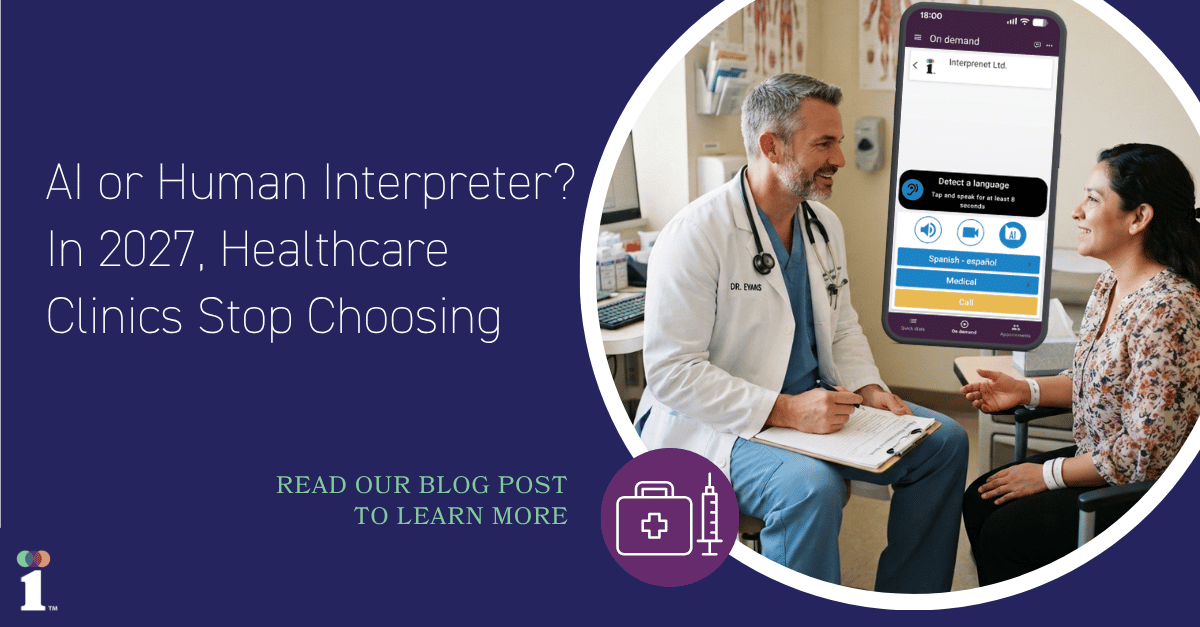
Walk into almost any conversation about language access in healthcare right now and you will hear the same question: should we use AI medical interpretation, or stick with human interpreters?
It is an understandable question.
For clinic leaders, the choice has mostly been framed as a trade-off. Legacy language providers put a human interpreter on every encounter, but a routine scheduling call costs the same as a critical one, and patients wait on hold for both. AI-only newcomers offer instant, low-cost interpretation, but when a conversation turns to a diagnosis, a consent form, or a patient in distress, there is no human interpreter available to handle those situations.
Patients do not experience their care as “AI moments” and “human moments.” They experience one visit, one phone call, one relationship with their clinic.
Language access today and in 2027 should work the same way.
Flexibility Isn’t a Feature. It’s How We Build.
Interprenet has just launched On-Demand Consecutive AI Interpretation for healthcare: AI interpretation for routine conversations, with a qualified human medical interpreter one tap away at any point in a conversation.
The idea is not new to us:
➡️Our Remote Simultaneous Interpretation platform already works this way for large meetings and events, with live human interpreters for the keynote and AI for the smaller breakout sessions.
➡️Our Classroom Language Assistant does the same for schools and universities: AI interprets back and forth between teachers and students, with a remote human interpreter available on short notice.
Every encounter sets its own terms, and our clients decide how to meet them. On-Demand AI Interpretation brings that principle into the clinic, built on more than 20 years of interpreting experience since we opened our doors in Chicago in 2004.
How AI Medical Interpretation Works in a Hybrid Model
Consecutive interpretation means speakers take turns: one person speaks, the interpreter renders it, the other responds. It is the natural rhythm of a front-desk call or a check-in, and it is the format our consecutive AI interpretation is built for. Every session follows four steps.
CONNECT. Staff start a session on any phone, tablet or desktop and choose AI mode or a human interpreter.
INTERACT. In AI mode, the platform detects the patient’s spoken language from 56+ options and interprets in the 25 most requested languages.
SWITCH. One tap rolls the session over to a qualified human interpreter, with coverage across 300+ languages, including ASL and rare languages.
REPORT. Every session is logged with transcripts, call summaries, consent, and a record of any AI-to-human handoff.
Where AI Fits, and Where It Stops on Purpose
Responsible AI interpretation starts with scope. AI is well suited to the high-volume, administrative conversations that fill a clinic’s day: scheduling and rescheduling, check-in and intake, insurance and benefits questions, reminders, and logistics.
A human interpreter belongs in the conversations where nuance, judgment and trust matter most: test results, treatment options, informed consent, and anything a patient finds emotionally difficult. Behavioral health sessions typically go to a human interpreter, not to AI.
Your team controls where that line sits. Clinics can configure how AI is used by role or use case, and any staff member can escalate the moment a conversation changes course, without hanging up or starting over.
For Community Health Centers and FQHCs
For federally funded health centers, language access is not optional. It is a condition of HRSA funding and is governed by Title VI and the ADA. Many centers serve patients across dozens of languages on tight operating budgets, which makes every interpreter minute count.
A hybrid model lets health centers move routine interactions quickly and at a lower cost, while keeping qualified medical interpreters available for clinical moments. Just as important, it produces the documentation compliance teams need: consent records, full audit trails, and a clear log of every handoff.
➡️Learn how On-Demand AI Interpretation supports community health centers.
For Private Specialty Clinics
Specialty practices feel the pressure first on the phone. If nobody can answer a referral call in the patient’s language, that patient often never books. AI interpretation recognizes the caller’s language and interprets within seconds, so the referral becomes an appointment instead of a callback.
From there, AI carries routine front-office traffic such as prior authorization updates, rescheduling and home program check-ins, while results, options and consent go to a human interpreter. It also closes a common gap: many practices lean on a bilingual staff member or a patient’s relative, yet under current Section 1557 rules, untrained bilingual staff and family members do not qualify as interpreters.
➡️See how it works for private specialty clinics.
What Responsible Hybrid Interpretation Looks Like
If you are evaluating AI interpretation for your clinic, these are the questions worth asking any provider:
- Is human escalation built into the same call? A separate service to contact is a workaround, not a safeguard.
- Can we control where AI is and isn’t used? Scope should be set by your clinic, by role and by use case.
- Is every session documented? Consent, audit logs and handoff records should be standard, not add-ons.
- Is our data used to train models? With Interprenet, it never is.
- How is the AI governed? Our AI governance aligns with the SAFE-AI Task Force framework, and the platform is built to HIPAA and SOC 2 Type II standards.
- Who stands behind it? You should be able to reach a person who knows your account and can adapt the setup as your needs change.
The efficiency gains are real. Across the industry, organizations using hybrid on-demand interpretation have connected patients to an interpreter up to 79% faster, reported up to 98% fewer language-related complaints, and cut interpreter scheduling admin by up to 60%.
Here are some questions we hear quite often from clinic leaders:
Is AI interpretation safe for patients?
Yes, when it is used for the right conversations and backed by human oversight. AI performs well in routine, administrative exchanges. Clinical conversations, consent and behavioral health sessions should go to a qualified human interpreter, and staff should be able to escalate instantly.
When should a clinic use a human interpreter instead of AI?
Whenever a conversation involves results, diagnoses, treatment decisions, informed consent or emotional distress, and whenever a patient or staff member asks for one.
What is hybrid AI and human interpretation?
It is a single platform where AI handles routine interpretation and a human interpreter can join the same session on demand, so clinics do not have to manage separate vendors for each.
How many languages does AI medical interpretation cover?
Our AI interprets in 25 of the most requested languages and detects 56+. Human interpreters cover 300+ languages, including ASL and rare languages.
Stop Choosing. Start Matching.
The question for 2027 is not “AI or human?” It is: which conversation, which kind of support, and who decides? At Interprenet, the answer to that last part is simple. You do. We bring the technology, the interpreters and two decades of operational experience, plus a team that picks up the phone.
Book a live demo of On-Demand Consecutive AI Interpretation for health centers or for private specialty clinics.
Or watch our CEO introducing Interprenet On-Demand below: