Your Vocabulary Used
Interpretation tuned to the terminology your practice actually uses, not a general medical approximation of it.
AI on-demand interpretation, built for the way an outpatient practices and specialty clinics actually run. From the referral call that turns into a booked appointment, to the visit itself, to the follow-up that keeps a patient in their plan of care.
Show me a quick demo
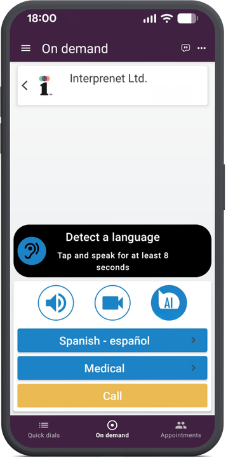

If someone can't answer the phone in the patient's language, they typically won't become a client. AI interpretation recognizes the caller's language and interprets in seconds. No hold, no callback.

AI interpretation carries the high-volume calls that fill your front office's day. Bookings, rescheduling, prior authorization updates, benefits questions, home program check-ins.

The moment a conversation turns to findings, options, or consent, one tap connects you to a qualified human interpreter. Behavioral health sessions always go to a human.
A physical therapy session and an oncology consult don't sound anything alike. We've been interpreting across a full range of subject matter since 2004, and our On-Demand AI Interpretation solution is built on it. Your team can answer in any language instantly, with the accuracy each specialty's vocabulary actually demands.
 One system instead of three vendors and a bilingual staff member.
A qualified human interpreter, on the same call, in one tap.
Answer a referral call in the patient's language instantly.
Trained on specialty terminology, not general medical audio.
One system instead of three vendors and a bilingual staff member.
A qualified human interpreter, on the same call, in one tap.
Answer a referral call in the patient's language instantly.
Trained on specialty terminology, not general medical audio.
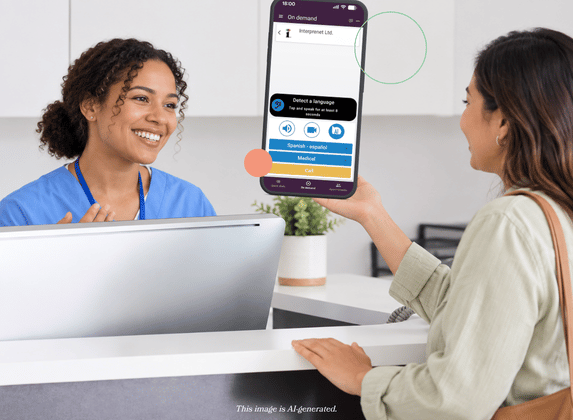
.jpg)
Pain scales, range of motion, "does this hurt here." A PT visit is a conversation as much as a treatment, and the answers have to be accurate to be useful.

Recurring visits, medication agreements, and procedures that need documented consent. AI handles check-ins and scheduling, a human interpreter covers consent, and both are on the record.
.jpg)
A patient who can't call to book never becomes a patient. AI interpretation handles scheduling, intake, and reminders. Clinical sessions are interpreted by a qualified human, never AI.
.jpg)
Months of appointments, symptom calls, and coordination, most of it logistics. AI interpretation covers the scheduling and follow-up while results and treatment decisions go to a qualified human interpreter.

High visit volume, short appointments, and a lot of post-procedure instruction. AI interpretation keeps a full schedule moving, with a human interpreter on the line when a biopsy result comes back.
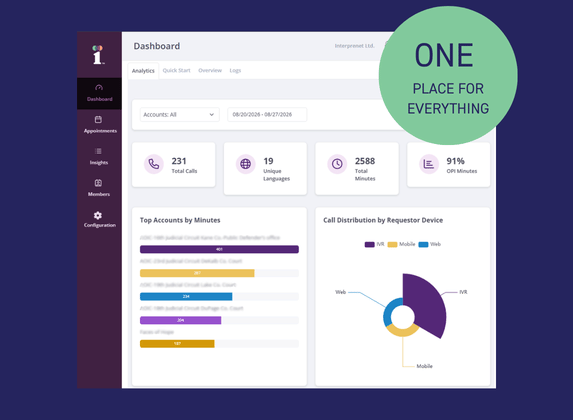
If your practice bills Medicare or Medicaid, Section 1557 applies to you — and most practices assume they're covered because someone on staff speaks Spanish. The 2024 rule is specific that they aren't. Untrained bilingual staff don't qualify as interpreters. Neither do family members.
Compliance here isn't a project you run. It's what happens when your team uses the app. Every session is logged with who interpreted, when, and in what language. Conversations stay encrypted, access is controlled by role, and nothing said on a call is ever used to train a model.
 Supporting HIPAA-sensitive workflows
Interpreters trained on your practice's terminology
Encrypted in transit and at rest
Every session logged and timestamped
Full audit logs & consent controls included
No model training on your data
Supporting HIPAA-sensitive workflows
Interpreters trained on your practice's terminology
Encrypted in transit and at rest
Every session logged and timestamped
Full audit logs & consent controls included
No model training on your data
AI interpretation works on the phones and devices your practice already uses — no new hardware, nothing to rebuild. It turns long calls into short ones, gives your front office back the hours a language barrier takes, and stays available around the clock, in whatever language your patient actually speaks.
Show me a live demo
Interpretation tuned to the terminology your practice actually uses, not a general medical approximation of it.

The interpreter is already there. Nothing to schedule, and no visit rearranged around who's available.

Results, consent, and behavioral health sessions go to a qualified human interpreter. One tap connects you.

AI languages, 300+ in total. When a patient speaks something outside that, a human interpreter covers it.
Request an interpreter instantly or book ahead: AI-only, human, or both.
 Any device: Phone, tablet, desktop
300+ languages in total
Any device: Phone, tablet, desktop
300+ languages in total
Start in AI mode. Auto detects spoken language from 56+ options, then interprets in the 25 most requested.
25 AI languages (and growing)
High, reliable AI accuracy rate
Roll over to human interpreters with one tap for seamless & safe conversations every time.
Control how AI is used
Qualified health & medical interpreters
Track interpreter sessions, manage audit logs, consent, and compliance documentation.
Receive transcripts & call summaries
Configure by user role or use case

Cut admin time for interpreter scheduling by up to 60% with on-demand AI & human interpretation.
300+ languages overall, including ASL and rare ones. 25 AI languages and growing.

Reduce operational costs of language access up to 60% using AI.

Give your team faster access to AI and human interpreters.
Our specialist is happy to show you a quick live demo.
.jpg)

 Contact our sales team: +1 877-808-5030
In simultaneous interpreting, the interpreter listens to the speaker and translates what is being said into the target language in real time. Special equipment such as headphones and microphones are usually used. The interpreting takes place almost simultaneously with the speaker's speech, with a slight delay of just a few seconds.
Remote simultaneous interpreting (RSI) involves interpreting from one language to another remotely and in real time. RSI enables conference interpreters to work from anywhere in the world via a cloud-based platform, meaning no delay, no extra equipment, and no barriers. This allows real-time interpreting by qualified professional interpreters to be added to any live event or conference, whether it is an in-person or virtual event, even in a hybrid format.
Our RSI platform is ISO 27001-certified for information security management. It uses enterprise-grade security to protect events, meetings, conferences from prying eyes and ears. Audio and video streams are encrypted using 256-bit encryption, while access to the tool is controlled by two-factor authentication (2FA) via SMS or email.
To support any number of languages and attendees, our cloud-based simultaneous interpretation technology can be integrated with your preferred online meeting solution, including Zoom.